
Deep Water
Sunday 19th July – Saturday 3rd October
Deep Water is site specific installation by painter Junko Burton and sculptor Frances Carlile. Made in response to each other’s work and to the gallery space together they explore ideas of fragility and transience; surface and depth; unease and loss.
Frances Carlile is an environmental artist. She works directly with the landscape to gather material from hedgerows, moorland and seashore. She uses abandoned and found natural materials from allotments and skips. The collected elements are constructed into fragile works. Some are cast into bronze and patinated, some contain copper plated fragments, and some are left as found. Her work is informed by myth and legends, journeys, navigation and the stars. She has exhibited widely, making site responsive installations as well as permanently sited work.
The polished concrete floor of the gallery resembles a vast and beautiful expanse of water. A grey washed sea. Fragile vessels voyage together over the watery surface. Some carry precarious dwellings. Transient and ephemeral, they form a reflection of loss, of solitude, the fleeting moment, the passage of time. Individuals embark on perilous journeys, each one solitary, each one charting their own passage over the deep water that lies beneath. Smaller vessels drift around the walls. This is the journey that we all make into the unknown. What does it mean to voyage so far, to leave security behind, to face uncertainty ahead.
Junko Burton is an artist influenced by two quite different values and aesthetics – of Japan where she spent her formative years and of the UK where she has lived most of her adult life. Her perspectives have formed through assimilating these two cultures. She sees fleeting moments in the natural world that would form ‘time’ and tries to capture the sense of fragility of each moment. As many are experiencing a time of unpredictability and vulnerability, some answers may be found in nature.
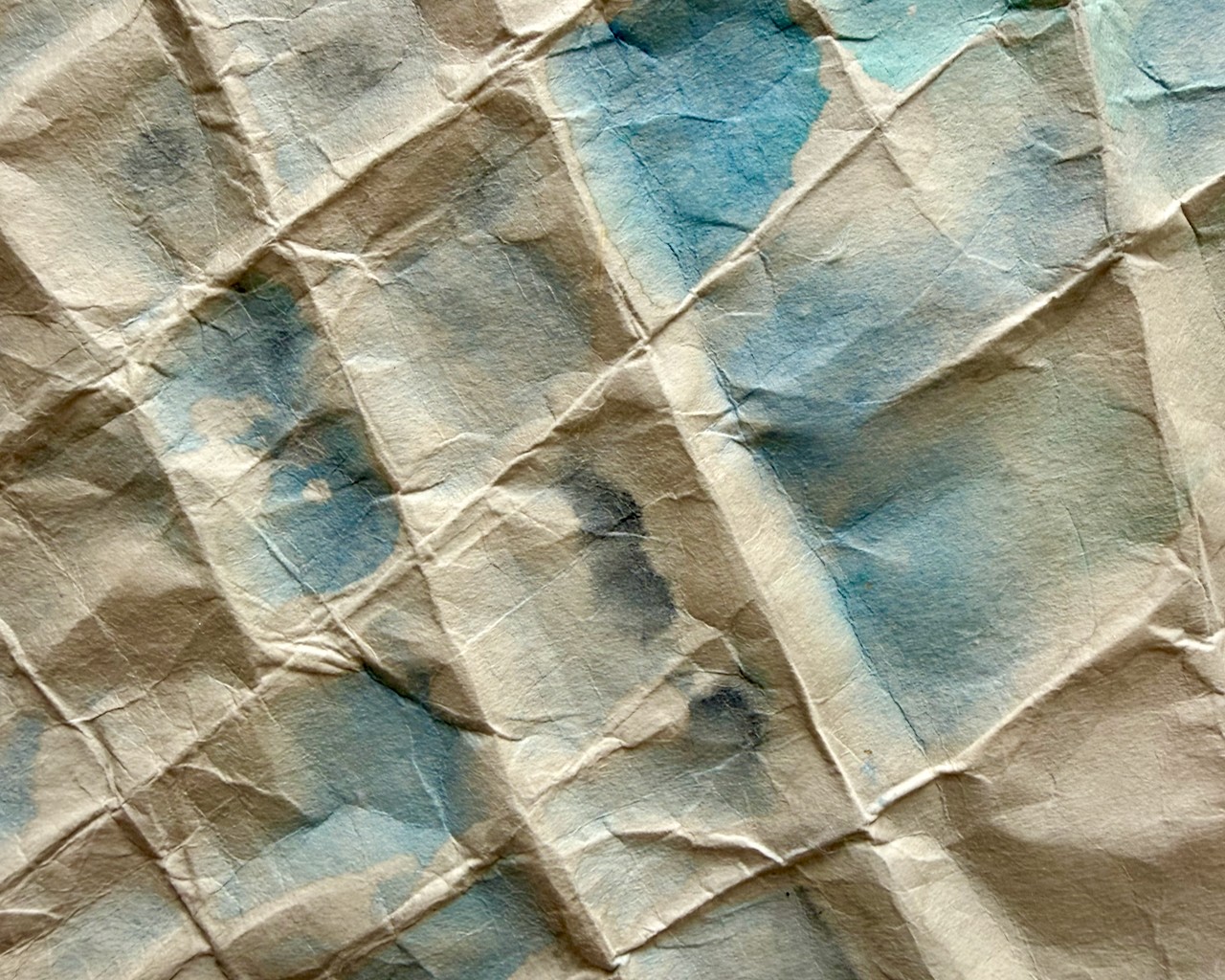
The gallery’s large space and high ceiling inspired her to express on a large scale the sensation she feels while looking into water from above. Larger pieces are painted with pigment and metallic powders on Asian papers. While both materials offer unique beauty and endless options to artists, unprescribed qualities of the raw materials challenge one’s ability to control and prompt them to let go. For smaller works, alcohol ink is used between encaustic layers in order to capture fragments of moments. Images emerging from capricious materials resonate with the way she sees time as the layers of moments.